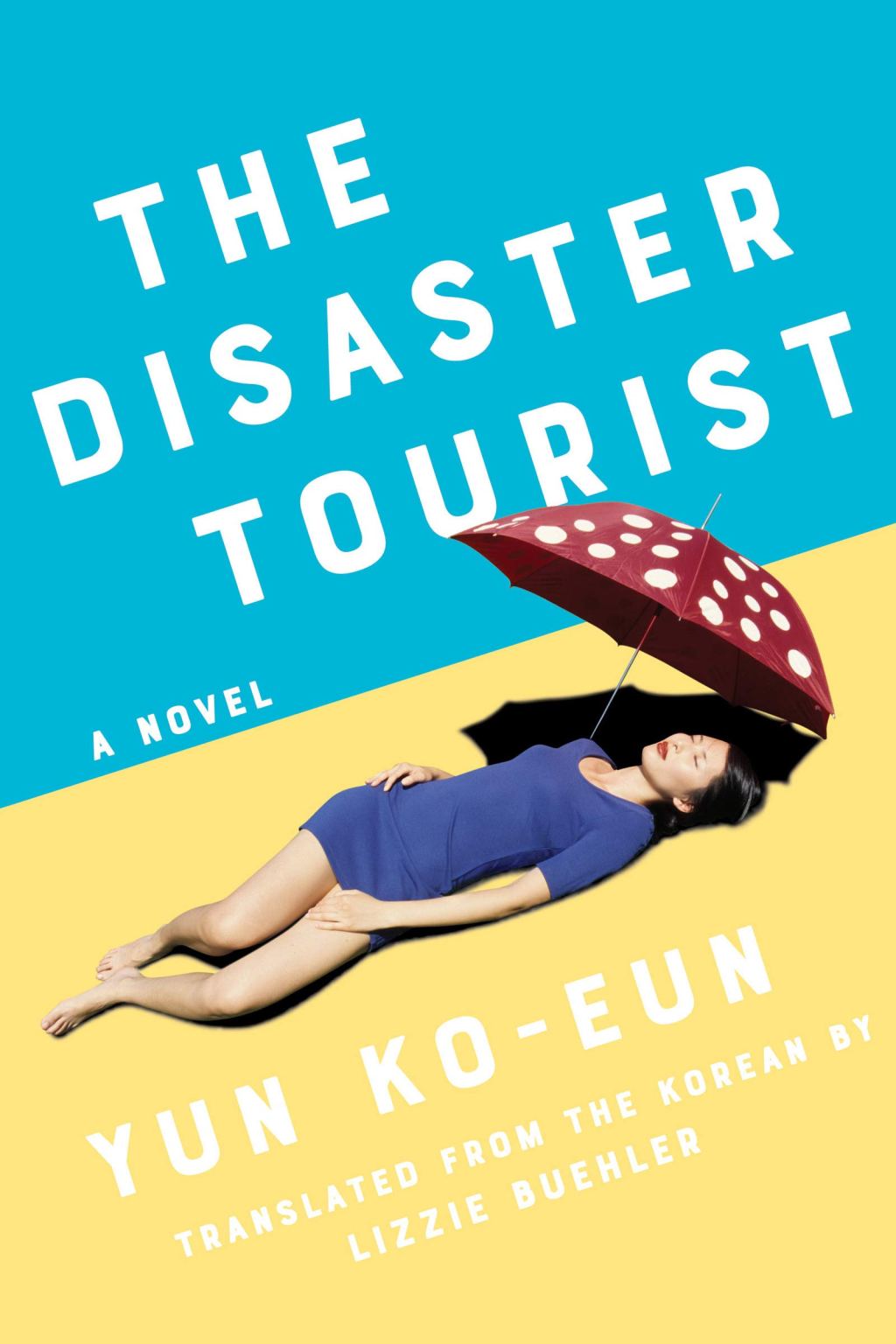
This review was originally submitted as part of the Korean Literature Review Contest with the Literature Translation Institute of Korea and was titled: How Bureaucracy and Capitalism Contribute to Cataclysmic Complacency: a review of The Disaster Tourist by Yun Ko-Eun because we like to have fun here.
“Disaster and catastrophe aren’t just within the realm of the gods.
Us humans, we can manipulate nature, too.”
Book Summary
In a time when social media influences travel based on the magnificence of the natural world, The Disaster Tourist follows a different kind of clientele—adventure-seekers with an appetite for landscapes ravaged by natural disasters. Yona is a top employee at Jungle, a travel agency that specializes in tours designed to inspire travelers to live dynamically, by sending them off to villages fallen victim to tsunamis, droughts, or earthquakes. After her supervisor sexually assaults her at work, she is left feeling helpless and humiliated. Instead of resigning, she is coerced into taking a paid “vacation” to Mui, one of Jungle’s island destinations at risk of termination.
While posing as a tourist, Yona gets swept up in a scheme to fabricate a natural disaster to attract tourists back to the island. With the facade of Jungle’s strict itinerary shattered, she realizes that she might have more sympathy for the people of Mui than she thought. With hundreds of lives at stake, Yona is forced to decide between submitting to her workplace abuser or her glittering potential in a new powerful position—and what to do about the massacre about to unfold.
Review and Analysis
Please be aware that there are light spoilers to major plot points ahead.
In September of 2021, Hawaii Governor David Ige pleaded for travelers to postpone their vacations as increased tourism triggered a surge in community Covid cases. Visitors were eager to break free from their work-from-home mundanity of the past year, lounging in oceanside hotels as local hospitals rapidly approached capacity.
As people are getting vaccinated and starting to vacation again, ethical travel is once again at the forefront of public discourse. The Disaster Tourist is a timely dark satire of how the tourism industry and global capitalism impact the environment and local communities that rely on international sightseers for income. While the world was—and in some places continues to be—under lockdown, our definition of “essential workers” has evolved to ensure that explicit economic needs are met. But who is profiting from the pandemic, and who is putting their lives at risk?
In The Disaster Tourist, author Yun Ko-eun captures familiar sensations that any traveler will recognize. From the thrills of exploring an unfamiliar place to the panic of taking the wrong train, Yun juxtaposes ordinary travel experiences against the backdrop of disaster tourism; a title that candidly conveys a phenomenon often ascribed more euphemistic terms in our real world, like voluntourism or ecotourism. By doing so, the author brazenly points the spotlight on the commodification of suffering for capitalist profit.
Yun’s main protagonist, Yona, begins her trip on the premise that she is visiting an exotic island with precarious sinkholes, treacherous volcanoes, and a bloody history of tribal warfare. Even from her luxurious beachside resort, she is still left underwhelmed by the overall scenery and lack of danger as advertised. “If we hadn’t been expressly told, would we even know this was a volcano?” Yona asks her guide. “And doesn’t this geyser just seem like a neighborhood well?” another traveler adds.
Yona and her travel companions are spectators to a suffering softened with years gone by, and they are disillusioned by the lackluster performance. The stage curtains are forcibly torn down after Yona is accidentally left behind by her tour group, exposing her to the lowly players in the tragedy: the Mui residents forced to sacrifice their dignity and lives to maintain the vile veneer. The faceless director of the drama is revealed to be Paul—a conglomerate that owns much of the land on Mui—even though Yona wonders who or what stands behind Paul. In her futile attempt to keep her own head above water, the scriptwriter and the manager both persuade Yona by promising her a powerful position in their production.
Yun expertly crafts a world of tension that surrounds her protagonist, deliberately centering Yona’s inaction in the face of multiple decisions that challenge her ethics. Yona is a difficult protagonist with whom to sympathize, but her flaws make her more compelling. Yona’s passivity is at times infuriating, as she is seemingly deprived of autonomy and easily manipulated by the men holding power over her. But as a character, Yona’s narrative reflects the realities of many women reduced to surviving in systems not designed to serve them. In a present day influenced by the #MeToo movement, what becomes of the women who don’t speak out against discrimination? It was discouraging to watch Yona keep her head down as her co-workers’ pleaded with her to join them in protest against her predatory supervisor. However, writing like Yun’s—that emphasizes societal failings—challenges readers to define their morals by asking them, “Well, what would you have done differently?”
No one believes they would willingly contribute to the suffering of others, but we consistently diminish our own impact on the environment by normalizing our consumption of plastic, fast fashion, and merchandise produced under oppressive working conditions. Yun expands on this environmental anxiety by exploring how systemized bureaucracy creates an attitude of helplessness and indifference:
“If someone had ordered her to push people into the sinkholes, Yona would have said no and left instantly. But because her contribution wasn’t direct, Yona stayed silent, and as she got more used to her position, she grew insensitive to the effects of her work.”
Yun Ko-Eun
Many of the other scripted players in the contrived catastrophe are methodically kept ignorant to the larger peril that threatens their lives. The key instigators are also convinced that they are simply doing their jobs for the good of Mui. Even though Yona is uncomfortable in the work she is doing, she wonders if there is such a job where the employees are not abused and pushed around to serve the needs of those in power. Like many of us, Yona finds herself entangled in her company’s identity, as both a puppet and puppeteer of capitalist profit. In both her office at Jungle and her time in Mui, she never acts on her apprehensions towards her superiors, and she continues to believe that someone above her will take responsibility for her safety.
For such a compact novel, Yun concisely captures the environmental dread that plagues many people today. The ending came rather abruptly, both for readers and for the inhabitants of Mui, simulating for readers a shock similar to that following a natural disaster. In the aftermath of the story, readers are compelled to contemplate their own contributions to capitalist chaos. Like the unstoppable swell of a tsunami, is there anything we can do to minimize the impending destruction of climate change?
Conclusion
The Disaster Tourist intimately scrutinizes Korean work culture and the burden of bureaucracy on Korean women. Yona’s experience is skillfully translated by Lizzie Buehler to be understood and accessible to any working woman. Though originally written in Korean before April 2014, the novel is a powerful warning against trusting authority absolutely, and international readers who are moved by Yona’s story would benefit from reading more about modern Korean incidents where vulnerable people were left by those entrusted to protect them. Ultimately Yun offers no solutions to the issues she highlights in her novel, but unlike the characters in her story, we as readers should take personal responsibility to think critically about our own complacency in prejudiced systems.The Disaster Tourist is a satisfying balance between the somber realism of Kim Jiyoung, Born 1982 and the vivid surrealism of The Vegetarian, and would appeal to international readers who are curious about feminism in a uniquely Korean context. The novel will also intrigue fans of Winter in Sokcho, as both stories center on women and skewed perception of “authenticity.” Justifiably marketed as an “eco-thriller,” The Disaster Tourist was shocking not because of incessant action scenes, but by well-paced psychological dissonance depicting the horrors of the modernization. Like the haunting silence after disaster strikes, the survivors and readers are left wondering, “Where do we go from here?”
Writing ⭐⭐⭐⭐
Plot ⭐⭐⭐
Themes ⭐⭐⭐⭐⭐

 Only Naengmyeon
Leave a comment