A love letter to new traditions and “inauthentic” cuisine.
Living abroad during the holiday season is a true test of homesickness. I’ve spent many Thanksgivings and Christmases away from home, video calling late in the evening to tune into my family’s Thanksgiving festivities. The first time I was abroad for the holidays, I had to balance the feeling of loss—of missing family gatherings and of separating myself from yearly tradition—with the optimist’s instinct to make the best of my situation.
Anyone who has been with me for my adult life knows that I take holidays and birthdays very seriously. I cling to the ritualistic spectacle of holiday traditions as my way of finding footing in the slippery passage of time. I hate the idea of “special days” slinking by unnoticed.
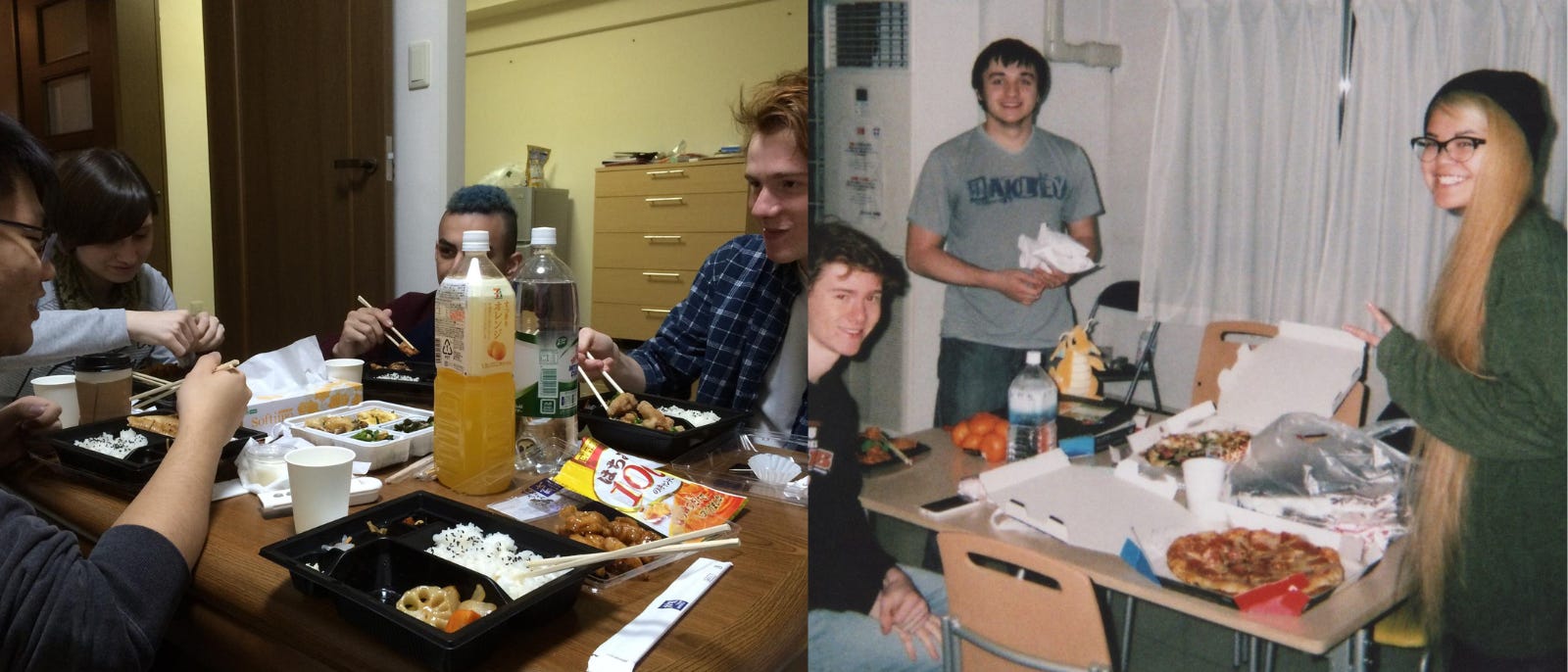
No matter where in the world I end up, my obsession with holidays often manifests itself in improvised celebrations—usually surrounding food. While studying abroad in Tokyo, my international friends and I celebrated Thanksgiving with store-bought bentos on my friend’s apartment floor. For Christmas that same year, we shelled out for expensive Japanese Domino’s pizza and ate together in our dorm’s common space.
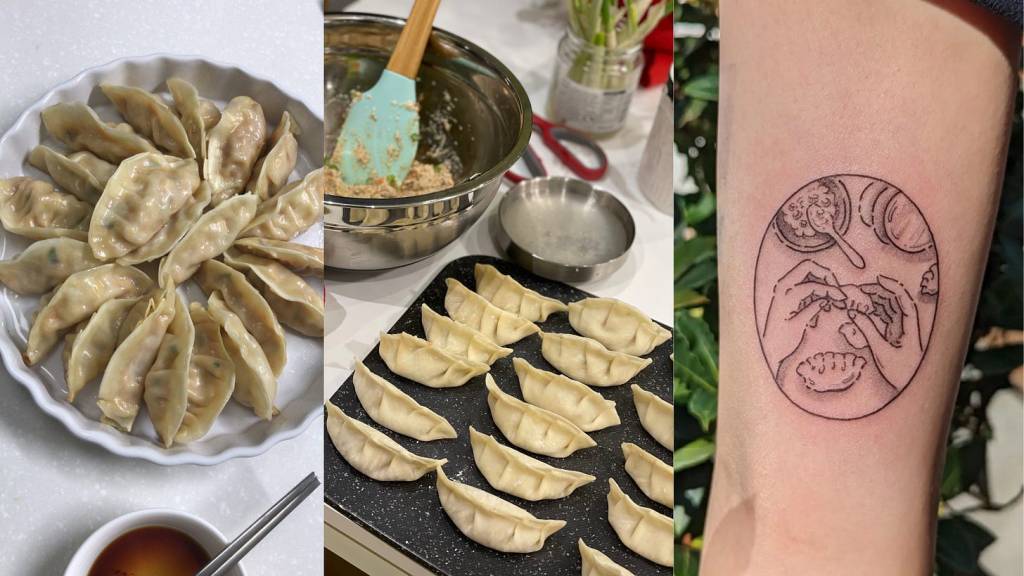
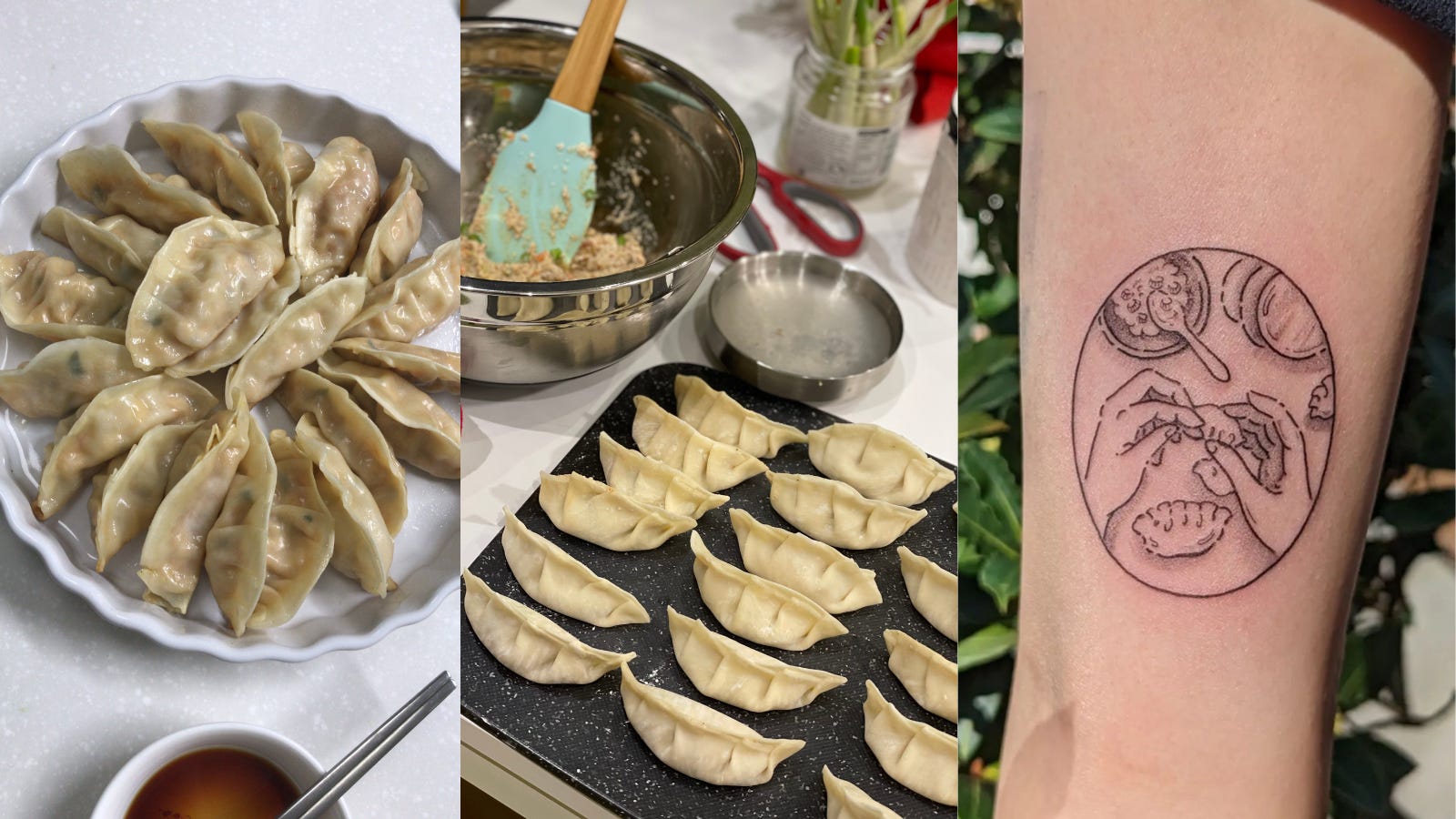
Holidays and food have been a major way in which I connect with Vietnamese culture, too. As an adoptee, Vietnamese culture remains an elusive collection of missed communications and generational knowledge lost. In high school, I asked my parents once to celebrate Tết with me, though none of us really knew how. Now, I celebrate every Tết by making dumplings with friends, a carryover from a childhood spent reading and loving Dumpling Soup by Jama Kim Rattigan and illustrated by Lillian Hsu. The story follows a young girl in Hawai’i named Marisa, and her first time making dumplings with her mixed family for New Year’s. This tradition is now so important to me that I got a dumpling tattoo on my arm.
For my dissertation, one of the books I wrote about, Scattered All Over The Earth (2018) by Yōko Tawada, is about a young woman, Hiruko, whose country has disappeared on account of capitalist greed. Left stranded in Europe, she repurposes words she’s heard to craft a new language that can be understood by all Scandinavian people. While trying to find others who share her heritage, she becomes frustrated that Europeans have diluted her culture so far from its roots that they don’t recognize it as culturally distinct. However, other characters in the novel posit, “When the original no longer exists… there’s nothing you can do except look for the best copy.” Belonging to no nation—both physically and linguistically—offers Hiruko a mobility that enables her to construct her own subjectivity outside of the confines of any nation. While the loss of national culture is the catalyst in the novel, it is irreparable, and Hiruko eventually learns that only she can create the language of her becoming. While at times I have felt like a facsimile of an Asian American, by mere merit of my skin color and birth certificate, I have to remind myself that I am not a deviation from an “original” version of myself that could’ve existed in Vietnam. Like the nationless Hiruko, it’s up to me to make the best of my circumstances.
While other Asian Americans have the privilege of proximity to their heritage, my Asian identity has had to be constructed deliberately through research and experimentation. Earlier this year, I went to the ESEA Literature Festival (East and South East Asian Literature Festival—read my piece in Wasafiri Magazine about it!) and attended a panel featuring Jeremy Chan of Ikoyi, a two-Michelin-starred restaurant in East London. I was struck by Chan’s philosophy of isolating ingredients from their conventional context to innovate their flavors and shatter traditional culinary boundaries. As a person of mixed race—I often find there’s immense overlap in mixed-race and adoptee experiences—he was positioned in almost an absence of any singular heritage, allowing him creative freedom in the kitchen. On “authenticity,” Chan challenged festival-goers to re-imagine our cultural reference points and reconsider our relationship to tradition, saying, “You can’t argue with the logic of flavor.”
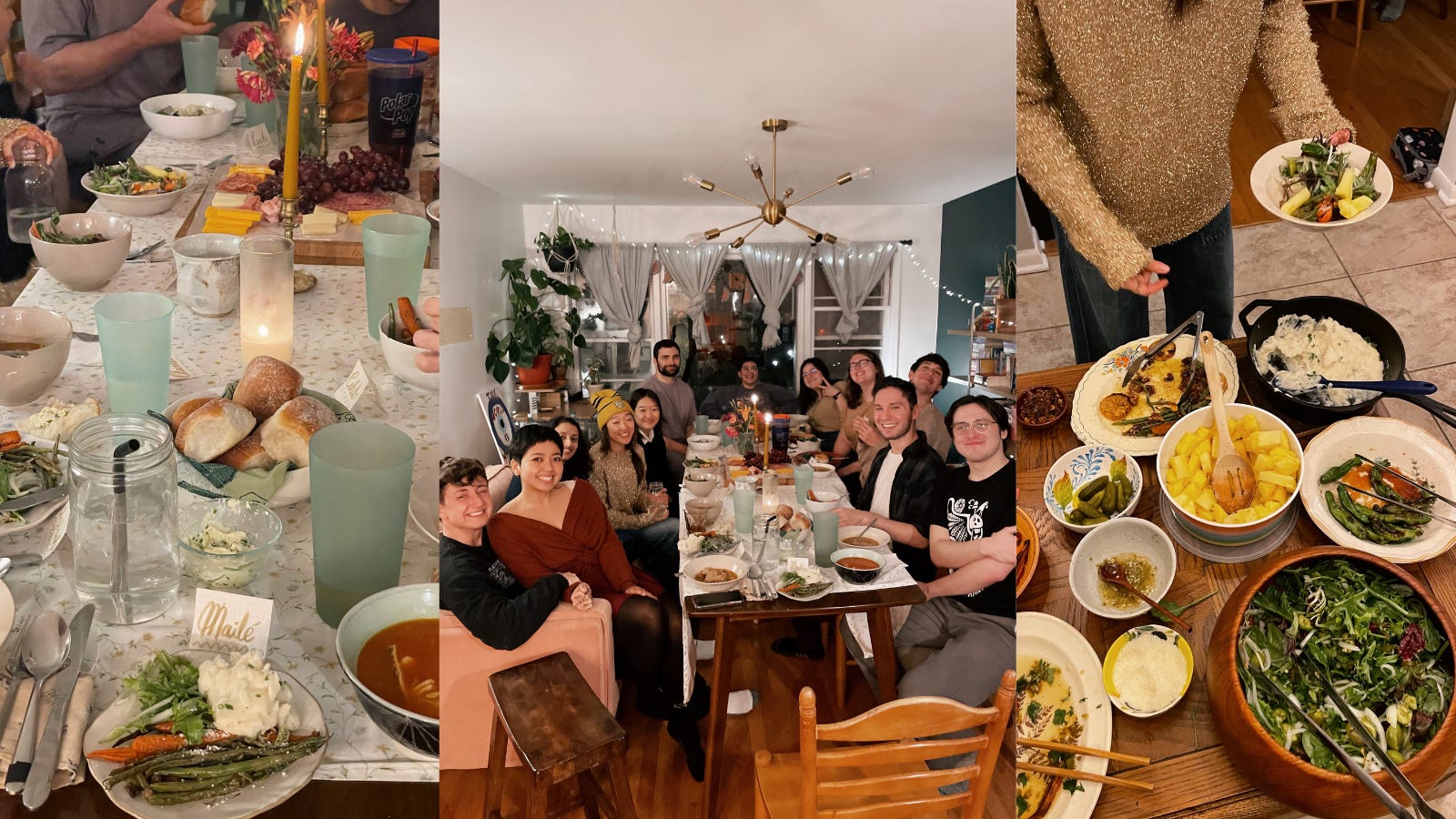
This Thanksgiving, Camila and I hosted twelve people in our modest Chicago apartment. In lieu of a Turkey, Camila made two Argentine soups: one called locro with hominy, beef, and pork and another tomato-based soup with fish. She had never made the soups before and was especially nervous about the fish—an ingredient she doesn’t usually cook with. “I’d like it to be authentic to the recipe,” she said as we visited four shops throughout landlocked Chicago looking for the right white fish. In the end, we spent $69 on a single filet of Chilean sea bass because it was the only one that came close to the fish in the recipe. While it was the most delicious fish soup I’ve ever had, admittedly I felt a bit torn by the cost of finding the “perfect” fish for the soup. I was reminded of morkovcha, a kimchi made from carrots. Unable to find napa cabbage, the traditional kimchi base, Korean diasporic communities in post-Soviet countries used carrots instead to create a new dish unique to the region—a mix of their heritage and circumstance. Would the soup have been delicious with another white fish? Perhaps, but perhaps it was less about the fish and more about affirming an identity, and no price tag can be put on that.
Months after the ESEA Literature Festival, Yōko Tawada and Jeremy Chan’s words still linger with me. Who controls narratives of authenticity, and does it burden us with unrealistic expectations? Does a platonic ideal of a dish even exist? Is a copy less valuable than the original? I’ve come to the conclusion that the myth of “authenticity” is reductive and threatens adoptees like myself into not partaking in our birth cultures at all. And I get it, cultural dilution is a real issue for diasporic communities placed within domineering Western cultures and there is definite value in the feeling of camaraderie that can come with remaining “true” to cultural reference points. However, in the absence of cultural memories tied to heritage, the thrill of producing tradition is mine alone. My position within hybridity as an adoptee can mean I belong nowhere or I can belong everywhere.
 Only Naengmyeon
Leave a comment