Please be aware that there is a content warning for graphic violence, death, and trauma from real historical events.
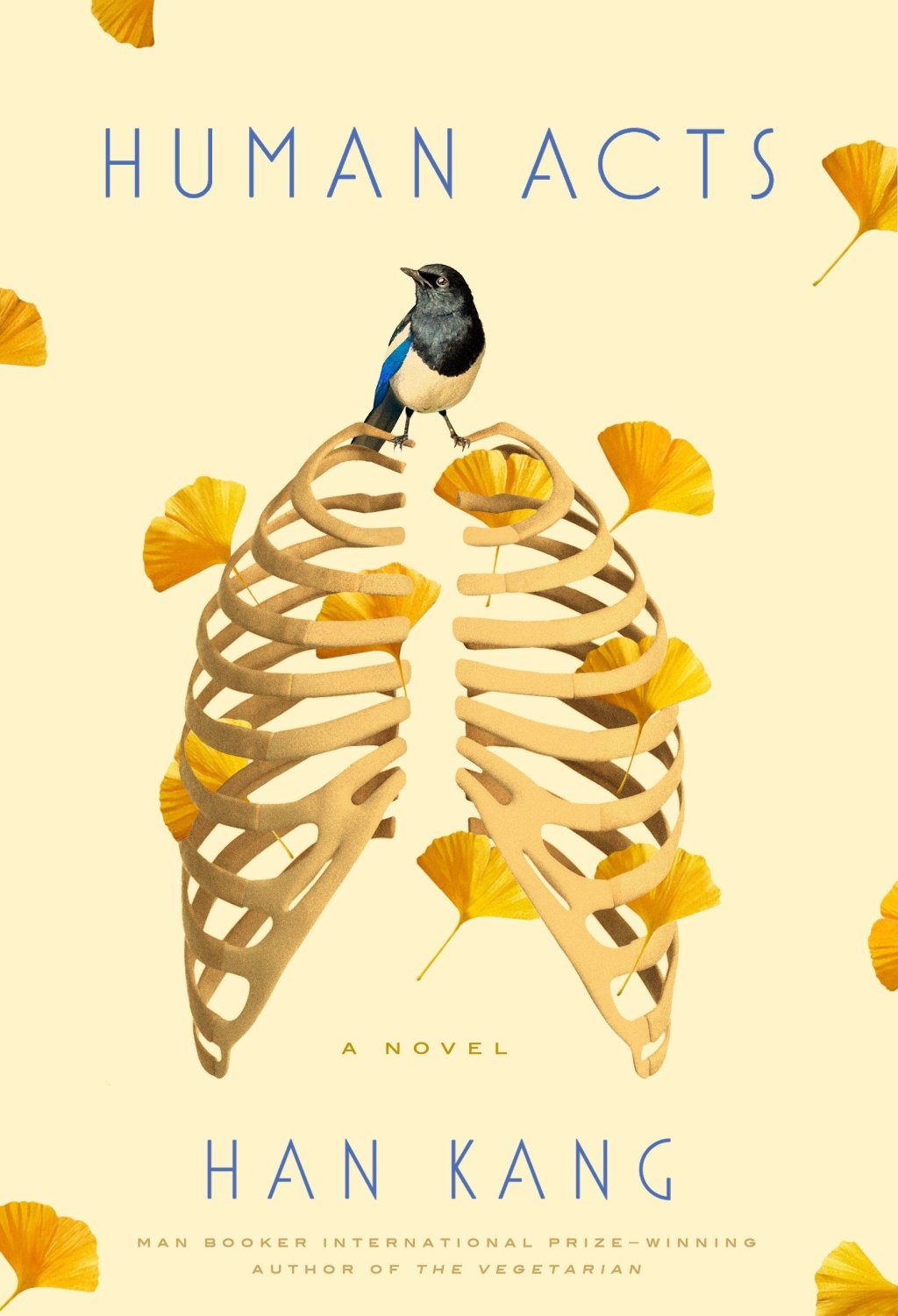
Human Acts is part historical account of the Gwangju Uprising and part lucid dream of grief and trauma. Han Kang muses about the cruelty human beings are capable of, and wonders if this brutality is fundamentally engraved into our genetic code.
The beginning of the book is told from the perspective of Dong-ho, a middle school student, who is watching the crowds of protestors when the military begins to attack and he is separated from his best friend. He watches as people are shot in the street, and all attempts at rescuing the bodies are thwarted by more bloodshed. While he is out searching for his friend, he is recruited to document the overflow of corpses in the Provincial Office, where he is tormented by the miasma of rotting flesh and the suffering of the bereaved. One of the most poignant lines of the novel comes from Dong-ho’s reckoning with national identity: “Why would you sing the national anthem for people who’d been killed by soldiers? Why cover the coffin with the Taegukgi? As though it wasn’t the nation itself that had murdered them.”
The following chapters are told from other victims who are trying to live their lives after the tragedy, all unknowingly connected by Dong-ho. From a grief-stricken mother, to an editor tasked with censoring the inhumanity of the massacre, they all struggle with trying to recover from their traumatic memories. All of them share an overwhelming grief for a life taken too young, “They were children. We handed out guns to children. Guns they were not capable of firing.” After the slaughter of peaceful protestors, Gwangju became synonymous with forced isolation and brutalization, butchered both physically and reputably in the eyes of wider Korea.
Human Acts reads as an attempt by Han Kang to ensure that the history of Gwangju is not erased. Interspersed among beautiful lines about souls and humanity are heart-wrenching historical accounts of suppression and Han Kang’s own political commentary:
When President Park [Chung-hee] was assassinated in October, you asked yourself: Now the peak has been lopped off, will the whole pyramid of violence collapse? Will it no longer be possible to arrest screaming, naked factory girls? Will it no longer be permissible to stamp on them and burst their intestines?”
One of the chapters is narrated by an editor, who was a high school student when she met Dong-ho while caring for corpses in the Provincial Office. At her work, she is forced to carry out the will of the authorities who are censoring all stories about the uprising. She wonders why the mourning are not allowed to grieve openly, how people can move on after such atrocities. The chapter adds an awareness that the novel itself is tackling a controversial event in recent Korean history.
This is my second Han Kang novel, and I must say that I can’t get it out of my head.
I lived in Gyeongsangbuk-do for three years. I lived in Park Chung-Hee’s hometown and even lived on a street named after him. I mention this because my primary intake of Korean history has been influenced by the seeming indifference to political uprisings that come with living in a “conservative” city. I had heard only whispers about the Gwangju Uprising, as well as the attitudes surrounding the Gyeongsang provinces and the Jeolla provinces. The book puts into perspective certain aspects of Korean mentality that I hadn’t been able to articulate—like this sense of victimization (han, for example is a loss of identity expressed by deep sorrow) and a history of tragedy. The modern Korea that we know is still so new.
Thoughts on the Translation
Shortly after reading Human Acts, I read an article in The New Yorker called “Han Kang And The Complexity of Translation” by Jiayang Fan. While I was reading the novel, I was so moved by the visceral descriptions of brutality as well as the sublime narration of each character. The article, however, pointed out that there were excessive embellishments to the text made by the translator, Deborah Smith. Which raises questions about the role of translators: is their job to enrich a text and make it palatable for foreign audiences, or is their job to remain true to the original text?
As a translated piece, I still maintain that Human Acts is a beautifully rendered piece of literature. However, there is something lost for me knowing that some of the beautiful lines I read may not have been present in the original. Fundamentally, this book is about grief and grappling with senseless violence and injustice. Oppression is not poetic.
One day, I hope I can read the book in Han Kang’s original words. Human Acts was one of my top reads for the year, and a novel that I will think about for a very long time. I highly recommend this book for fans of Han Kang’s other novel, The Vegetarian, but also anyone who has ever had an interest in modern Korean history.
Writing ⭐⭐⭐⭐⭐
Plot ⭐⭐⭐⭐⭐
Themes ⭐⭐⭐⭐⭐

 Only Naengmyeon
Leave a reply to The Best Books I Read in 2021 – Only Naengmyeon Cancel reply